

“Learning is the byproduct of the activity of the learners” – John Dewey
For all ages, learning is a continuous and evolving process. The knowledge and skills we manage to acquire in one context, becomes our foundation for understanding and navigating similar situations in the future, often leading to new and improved outcomes. In essence, growth is possible only through dynamic engagement with experience: hence we learn, relearn and at times unlearn through our experience. This ongoing cycle of experiences, shapes our learning abilities through all four modes, in a way that it influences how we interpret new experiences and determines our capacity for future learning.
“That past experience has indeed not been useless, but its use is not in guiding present conduct by past situations. We must put everything we can into each fresh experience, but we shall not get the same things out which we put in if it is a fruitful experience”– Mary Parker Follet (Pioneer in Organizational Theory).
As discussed in a previous chapter on “Flexible Learning Style: Key to Unfolding the Capabilities of Our Children”, the four learning modes/abilities within the experiential learning cycle, which we will discuss in detail here, are the governing factors for a dynamic experiential learning process.
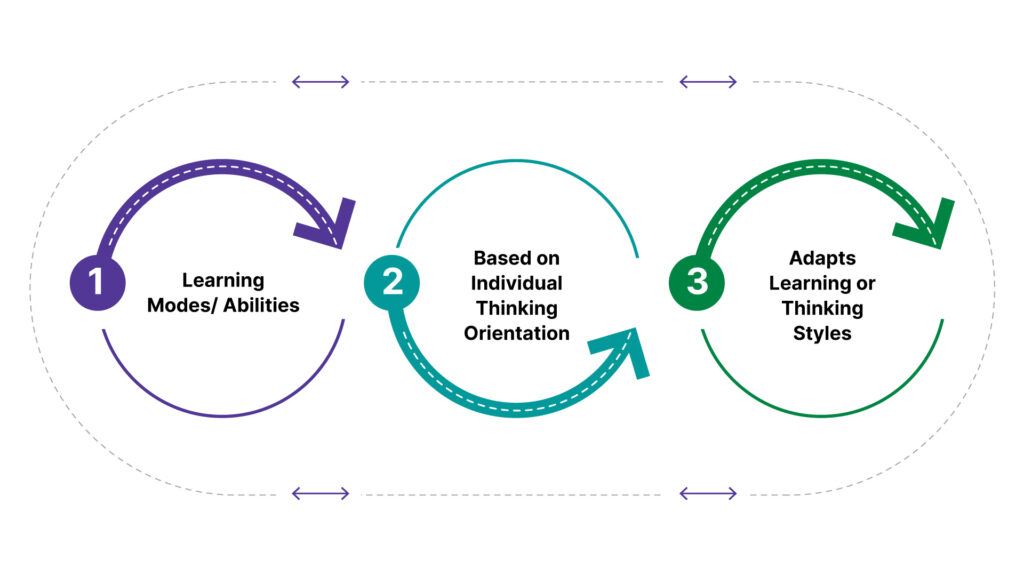
The learning process shown in the diagrammatic representation above is not at all linear; infact, it is more cyclical and dynamic. Depending on the context and demands of any situation, each individual draws upon different learning styles and modes. Movement through these modes is very fluid, not at all sequential, allowing adaptation to new challenges and experiences.
Before exploring this learning cycle in greater depth, it is important we briefly examine the foundational research on the various ways individuals learn.
Expert theories on ways we learn
Across decades of research, scholars have offered distinct yet complementary perspectives on how learning occurs.
After decades of research, various psychology scholars have offered distinct and complementary perspectives on how learning occurs.
Behavioral theories of learning emphasize the role of conditioning and past experience in students. From this viewpoint, learning for each individual is shaped by stimulus, response, reinforcement and repetition. What we practice and experience – particularly through direct, first-hand engagement, forms different memory patterns that guide our future behaviour. So, according to this theory, learning becomes observable through measurable changes in action over a period of time. Therefore, Behavioral theorists focus on how a student or child behaves in a given situation rather than on their internal thoughts, mental processes, or their level of understanding.
For example:- If the teacher explains to the class that ½ means “one part out of two equal parts.” Students are then given multiple worksheets and asked to do the below:
- Shade ½ of a circle.
- Identify correctly ¾ from a set of options.
- Simplify 2/4 into simplest form.
From a behavioral perspective, a teacher checks for literal measurable actions:
- Did the student shade exactly one out of two equal parts?
- Did the student correctly select ¾?
- Did the student simplify 2/4 to 1/2?
✔ Correct answers = Evidence of learning
✘ Incorrect answers = Need for more reinforcement
So, over a period of time, the student will form the correct response patterns through repetition and reinforcement.
Cognitive theories of learning, on the other hand, focus on the internal mental processes that shape understanding of the child. These theories suggest that as children grow, they construct many mental models or cognitive neural frameworks that help them interpret and respond to their environment in future, based on the understanding they had when solving a problem today.
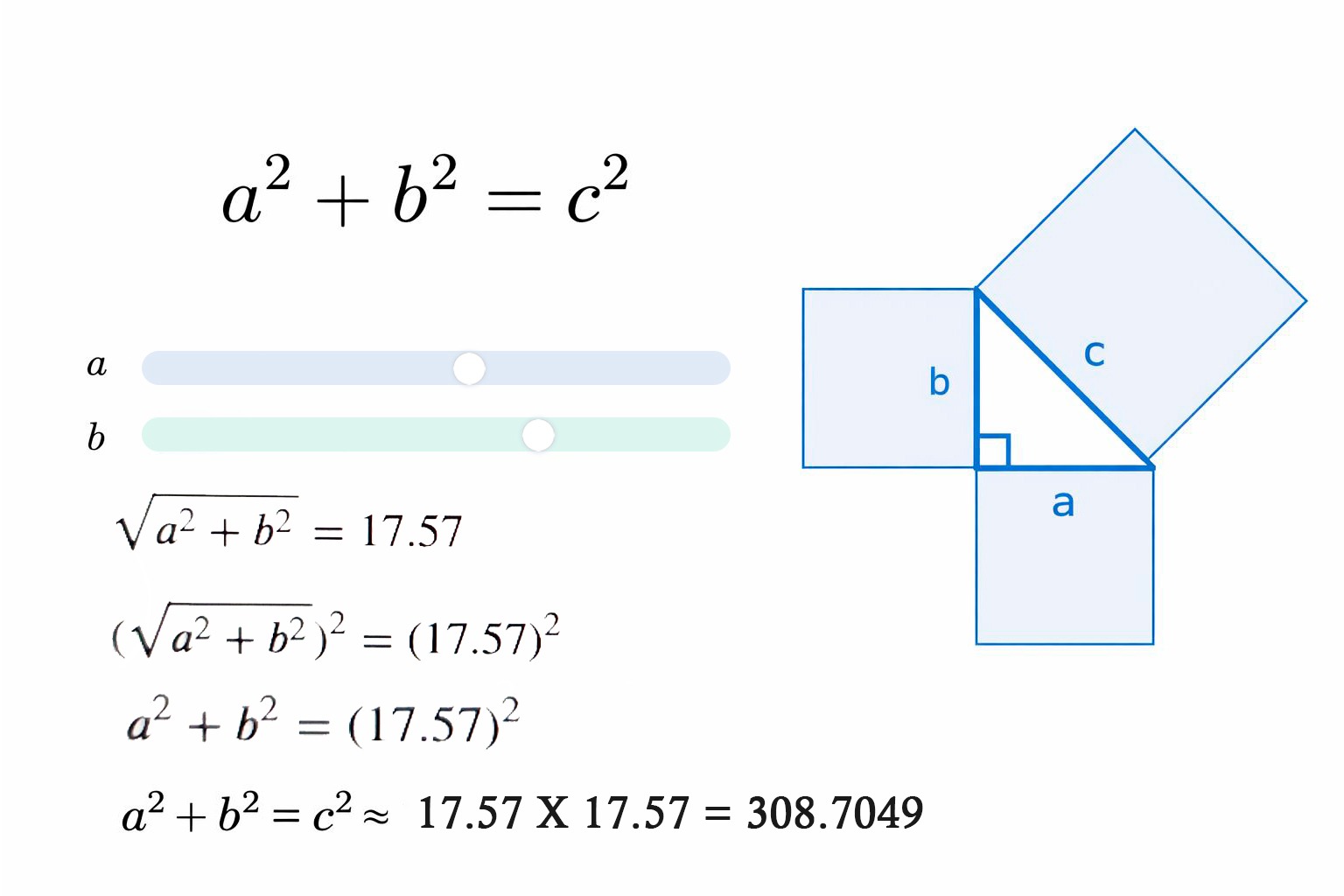
Example shown above emphasizes on Cognitive Learning:
Rather than just memorizing the equation, the teacher finds it more important to check if the student understands the concept:
- What’s a right triangle?
- Why do the squares of the two shorter sides equal the square of the hypotenuse or longer side?
- Why does the formula work only for a right triangle?
The teacher also checks for problem solving & reasoning abilities
- Develops the ability to apply the concept to new and different problems
Highlight:-
- It involves thinking and understanding, not just repetition
- The learner processes information mentally.
- Knowledge can be transferred to new situations.
An example we need to discuss here is the work of psychologist Jean Piaget, whose theory of cognitive development outlining the four stages of growth in children.
- The Sensorimotor Stage (0–2 years): In this stage, children primarily learn through sensory exploration – with touch, feel, grasp and by interacting physically with their world.
- The Preoperational Stage (2–7 years): During this stage, children begin forming mental representations, symbols and images of the world around them.
- Subsequent stages in the model defined by Piaget, further refines reasoning, logic and abstract thinking from 8 to 11 and 12 to14 years.
So, the progressive structuring of our thoughts based on our experiences is according to Piaget what makes learning happen and not just accumulation of facts.
Thus the next model, the experiential model of learning explored by pioneers like David Kolb; presents us a much more holistic approach to learning, beyond the two models we discussed above. Experiential learning theory views learning as a continuous process involving experience, reflection, conceptualization and action. So, in this model knowledge emerges through the transformation of experience and integrates both behavioural action and cognitive processing besides acknowledging the deeper, often implicit dimensions of learning in a child, such as: emotions, intuition and personal reasoning.
Albert Einstein has wisely emphasized the value of live engagement over passive instruction:
“Learning is experience. Everything else is just information.”
Let’s try and illustrate this further, considering the approach of two children learning about plants. One child, memorized in detail the parts of a plant from the textbook and the another child at the same time, literally plants a seed, waters it daily, observes its growth and records the changes. While both children may acquire knowledge; the second child develops a much better understanding of the process through transformed experience: integrating observations, patience, responsibility and reflection. Thus, such a learning process becomes more transformative for the child instead of being just informative.
I strongly believe that a child’s true potential is shaped by the quality of experiences they encounter. Thus, the right experiences- timely, challenging and reflective, become catalysts for growth.
Therefore, in this chapter, we will explore children’s learning abilities through the lens of experiential learning, examining how thoughtfully designed experiences can unlock deeper understanding, adaptability and lifelong learning capacity.
How do we define a Learning Cycle?
According to experiential learning theory, learning is defined as a process in which knowledge is created through According to the theories of experiential learning, the process of learning is defined as a cycle through which knowledge is created from the transformation of an experience. Or, in other words, learning occurs when a student both grasps an experience and transforms it. This continuous and dynamic process is called the learning cycle.
Below is the iterative process of learning
Learning Cycle = [Grasping Experience + Transforming Experience] Iterative
Grasping refers to how a learner acquires information, while transforming refers to how the learner interprets, reflects on, or acts upon that information. There are two primary modes of grasping experience:
- Concrete Experience
- Abstract Conceptualization
Learners may grasp information through abstract conceptualization, which involves understanding ideas through logical reasoning, symbolic representation, or theoretical interpretation. This process is often described as comprehension.
Alternatively, learners may grasp information through concrete experience, which involves direct, tangible and immediate engagement. This form of learning is based on feelings, sensory involvement and personal experience; often referred to as apprehension.
The two learning modes used for transforming experience are:
- Reflective Observation
- Active Experimentation
Once information is grasped, it must be transformed for learning to occur. This transformation can happen in two contrasting ways: either through internal reflection (Reflective Observation) or through external action (Active Experimentation).
In Reflective Observation, the learner carefully thinks about, analyzes and reviews the experience. In Active Experimentation, the learner applies the new knowledge, tests ideas and engages in practical action.The way any student transforms experience, often depends on their individual orientation too. This orientation is influenced by various factors that include their personality type, interests of the child, curiosity and of course passion. Thus these factors shape how a student prefers to process and act upon new information.
We will explore this in more detail later in this chapter.
Learning Ability Vs Learning Styles:
The terms learning ability and learning style are often used interchangeably, in the education world; even though they refer to two different concepts.
Learning Ability:- As per David Kolb’s theory, learning abilities of a child refers to the core capacities he/she would use to process experience within their learning cycle. These abilities are defined as – Concrete Experience, Reflective Observation, Abstract Conceptualization, and Active Experimentation [ Will discuss this in detail later]
These abilities describe how learning happens or how the learner grasps and transforms experience/information into knowledge. It’s important to also note that Learning abilities are developmental. Every learner possesses all four abilities to some degree and effective learning occurs when a student can engage in the full cycle. The goal of education, therefore, is to strengthen and balance these abilities over time.
Learning Styles:- Learning styles simply describes a learners preference or comfort zone when engaging with information or how comfortable they are with the way the teacher presents them the information. For example, some students may prefer :
- Visual input (diagrams, charts)
- Auditory input (lectures, discussions)
- Reading and writing
- Kinesthetic engagement (hands-on activity)
Learning styles is thus focus on how information is presented, for the learner whereas Learning ability refers to the deeper cognitive process behind learning, through which experience is grasped, interpreted, and transformed into knowledge.
Four Learning Abilities in the Learning Cycle: –
For any child, effective learning occurs when he/she moves through four interconnected abilities of learning. Each represents a different way of grasping and transforming experience. While most of us are not aware of this, individuals may naturally prefer one learning mode over the other. Though meaningful learning develops only when all four abilities are engaged. Let’s discuss this in detail:
1. Concrete Experience (Feeling & Experiencing)- During this phase of learning, the children would prefer to learn from an experience based on what was the emotion triggered and the sensory information gathered, rather than from abstract analysis. A child involved in learning through concrete experiences acquires knowledge through direct involvement and personal engagement.
Students who are very strong in this ability prefers more hands-on activities, real-life examples or demonstrations, storytelling and practical engagements to trigger their learning process. They learn best when they can see, touch, feel or actively participate in what is being taught. More than theory, they connect first or easily with live experience.
Kids who are profound with the ability to learn through concrete experiences better are often more open-minded and adaptable. They thrive in unstructured environments that allow possibilities for exploration. They are very good with personal connections and intuitive understanding.
2. Reflective Observation (Watching & Observing)- Children with this ability of learning observe keenly and involve thoughtfully, examining different experiences before taking definitive action. They consider various perspectives of the subject they are observing and make meaningful connections from what has occurred.
Students who developed this learning ability prefer to listen carefully, gathering as much information about the subject and think deeply before responding. These kids are often patient, open-minded and capable of seeing multiple sides of a situation. Without reacting quickly, they analyze and evaluate thoroughly.
Their strength lies in insight, careful judgment and the ability to connect present experiences with past understanding.
3. Abstract Conceptualization (Thinking & Theorizing)- Kids with this ability, involve themselves understanding experiences through ideas, formulas, logic or a theoretical explanation. They emphasize on reasoning, analysis and the use of symbolism or models enabling them to structured approach.
These students are comfortable working with theory or abstract concepts and they seek to understand the underlying principles behind each event. They usually prefer clarity in explanations , organized content, formulas or frameworks and discussions that define concepts.
These children show ability in building coherent explanations, systematic planning and in logical thinking.
4. Active Experimentation (Doing & Applying)- Active Experimentation (Doing & Applying)- Kids with accomodative approach learns by testing ideas, solving problems and exploring how concepts work in the real world.
These students who have this learning ability enjoy trying new approaches, conducting various experiments and loves engaging in anything that involves problem solving. Their learning cycle thoroughly involves – doing and refining their thinking through action.
Their strength lies in taking initiative, ability to adapt and the ability to turn ideas into practical outcomes.
Highlight:- The four learning abilities – Concrete Experience, Reflective Observation, Abstract Conceptualization and Active Experimentation- represent the complete learning cycle through which experience becomes knowledge. While individuals may naturally prefer one mode over another, true learning occurs when all four abilities are engaged. A learner’s individual orientation may influence where they begin in the cycle, but educational growth lies in developing the flexibility to move through each stage. Strengthening all four abilities enables deeper understanding, adaptability and more meaningful learning.
Key Insight:- A child’s individual orientation – shaped by personality, curiosity, interests and prior experiences; naturally inclines them toward certain learning modes. While this preference can create comfort and confidence, overreliance on it may restrict cognitive flexibility. True educational growth occurs when learners are gently encouraged to move beyond their dominant style and engage in the complete learning cycle.
Internalizing information (Grasp + Transform) depends on individual orientation
As discussed in previous chapters, knowledge is created through the combination of grasping experience and transforming experience, which together we call the Learning Cycle. However, the way knowledge will be internalized by different individuals will not be identical at all. It is influenced by the learner’s individual learning orientation – i.e., their natural tendency towards certain learning styles or learning abilities within the learning cycle matters.
Drawing from Guilford’s Structure of Intellect Model (creative process) and Kolb’s Learning Theory (KLSI 4.0), internalized knowledge may take four primary forms depending on which learning abilities are dominant.
Convergent Orientation:
Dominant Learning Abilities: Abstract Conceptualization + Active Experimentation
Convergent – oriented learner/thinker internalizes knowledge by applying the information they have learned so far, to solve a specific problem. Their focus is always on arriving at a decision or a single best solution. They don’t generally carry much emotional attachment to the knowledge they gain; their emphasis is more on practicality, logic and action.
Such individuals tend to have a more decisive style. They evaluate the alternatives, select the most effective option available and move toward closure. In such cases, knowledge is internalized as a tool for solving the immediate problem in hand and task completion.
This orientation is especially valuable in technical fields, decision-making roles and situations requiring efficiency and precision.
Divergent Orientation:
Dominant Learning Abilities: Concrete Experience + Reflective Observation
Divergent-oriented learners are generally ideation masters and they internalize knowledge more by generating multiple perspectives and possibilities. Their minds don’t allow them to stick to the first correct answer they are provided, instead they expand their ideas or collect diverse information, imagine alternatives and view situations holistically.
These individuals often demonstrate creative energy and emotional sensitivity. They are strong in brainstorming thoughts, generating new ideas and for seeing connections others may overlook. Knowledge gives them purpose and thus a meaning for creative exploration.
Divergent orientation is particularly valuable in artistic, innovative and leadership contexts. Effective leaders and managers often shift between divergent and convergent thinking depending on the demands of the situation.
Assimilative Orientation:
Dominant Learning Abilities: Abstract Conceptualization + Reflective Observation
Assimilative thinkers/learners internalize knowledge by relating new information to abstract principles, theories or even conceptual frameworks they have already learned. Their learning process gives more emphasis on logical coherence and intellectual understanding and would not haste into action.
These kids through assimilation fits new experiences into existing knowledge or mental models and schemas. Such learners prefers to learn in a structured environment and likes explanations and systematic analysis. Their strength generally lies in building theoretical models and organizing complex information into clear comprehensible frameworks.
This orientation plays a strong part in academic, research and analytical environments.
Accommodative Orientation:
Dominant Learning Abilities: Concrete Experience + Active Experimentation
Accomodative learners or thinkers internalizes knowledge through action and adaptation. They don’t generally settle by fitting experiences into existing concepts, rather they adjust or even reconstruct their mental frameworks based on new experiences.
Generally learners with this orientation prefer more hands-on engagement and when driven with curiosity are comfortable taking risks, trying new things or approaches; even if that means learning through trial and error. Knowledge in this type of learners is internalized dynamically and is open to reshape it through direct involvement.
People of this orientation generally are very active in entrepreneurship, innovation and experiential leadership.
Key Insights:
Knowledge is internalized based on the way we act upon the information we receive through our senses. As learners repeatedly grasp and transform based on the information they are exposed to; it’s usually through their dominant orientation that their understanding deepens and gets refined.
But growth from novice to mastery does not occur merely by accumulating information, but by ensuring we consciously engage through multiple orientations within the learning cycle. When individuals learn to balance and flex between convergent, divergent, assimilative and accommodative modes, they expand both competence and creativity.
Thus, individual orientation of learners shapes not only how we learn, but also what kind of thinker we ultimately become.Interesting note: – Beyond natural learning ability, personality types also play an important role in shaping an individual’s learning orientation. Eventhough this aspect is not taken into consideration in traditional schooling approach, the way a person prefers to engage with information, make decisions and adapt to situations is often influenced by their personality tendencies too.
Personality Types and Individual Orientation to Learning:
Personality types also play an important role in shaping an individual’s learning orientation. The way a person prefers to engage with information, make decisions and adapt to situations is often influenced by their personality tendencies.
For example, individuals with more extroverted tendencies may feel comfortable moving quickly toward decisions and acting on observable facts or concrete events. They often process ideas through interaction and external engagement. In contrast, individuals with more introverted tendencies may prefer to gather additional information, reflect carefully and process ideas internally before arriving at a decision.
These differences highlight how adaptive processes in learning are influenced not only by cognitive abilities but also by personality structure. (For further understanding of these distinctions, see Jung’s theory of psychological types and his explanation of human adaptive processes.)
Conclusion:
To conclude, learning is not a single event, nor is it merely the accumulation of information by an individual. It becomes learning, only when the student goes through a process where the information is grasped, reflected upon, conceptualized and applied. This process is called the Learning cycle and it reminds us that knowledge is created through the continuous transformation of experience. This is where creative schooling comes into play, as there we focus more on the learner rather than just transfer of information.
The four learning abilities- Concrete Experience, Reflective Observation, Abstract Conceptualization and Active Experimentation are not any isolated traits as they seem. They are interconnected capacities within any child, that wire together to shape meaningful understanding. Not all learners use all these traits by default; each one will have their natural preference; which is the influence of personality, curiosity and prior experience. Transformational growth in the child lies in developing the flexibility required to engage in all four modes of learning.
Individual orientation determines where a learner begins in the cycle and how knowledge is internalized, whether through convergence, divergence, assimilation, or accommodation. Yet true mastery emerges not from remaining within one’s comfort zone, but from learning to move fluidly across modes of thinking and acting.
Education, therefore, should not aim to label learners, but to expand them. It should nurture the ability to experience deeply, reflect thoughtfully, think critically and act courageously. When learners develop balance across the cycle, they do more than acquire knowledge: they transform it into wisdom.
As someone wisely said:-
We learn when we see,
We learn when we feel,
We learn when we ask
And when we reach out to touch..
From thought to action to insight,
The wheel keeps rolling,
Lighting what’s dark,
Into Quiet corners of wisdom!!!