

“Learning is the byproduct of the activity of the learners” – John Dewey
Learning is not a one-time event—it is a continuous, evolving process. Every experience we encounter shapes how we understand the next. We learn, relearn, and sometimes even unlearn. This dynamic process gradually builds our learning abilities and influences how we interpret the world around us.
As Mary Parker Follett beautifully expressed, past experiences are not meant to be repeated, but to enrich how we approach new ones. True learning happens when we actively engage with each new experience and transform it into meaningful understanding.
Understanding How Learning Happens
Over the years, different theories have tried to explain how learning occurs:
- Behavioral Theory focuses on repetition, reinforcement, and observable actions. Learning is measured by correct responses and practice.
- Cognitive Theory emphasizes thinking, understanding, and mental processing. It explores how children build internal frameworks to interpret the world.
Psychologist Jean Piaget highlighted how children develop through stages—from sensory exploration to abstract thinking—showing that learning is deeply connected to cognitive growth.
However, a more holistic perspective comes from experiential learning.
Experiential Learning: Learning Through Experience
Pioneered by David Kolb, experiential learning explains that knowledge is created through the transformation of experience. It combines action, reflection, thinking, and application.
As Albert Einstein said, “Learning is experience. Everything else is just information.”
For example, a child who memorizes parts of a plant may gain information, but a child who plants a seed, observes its growth, and reflects on it gains true understanding. The second experience is not just informative—it is transformative.
What is the Learning Cycle?
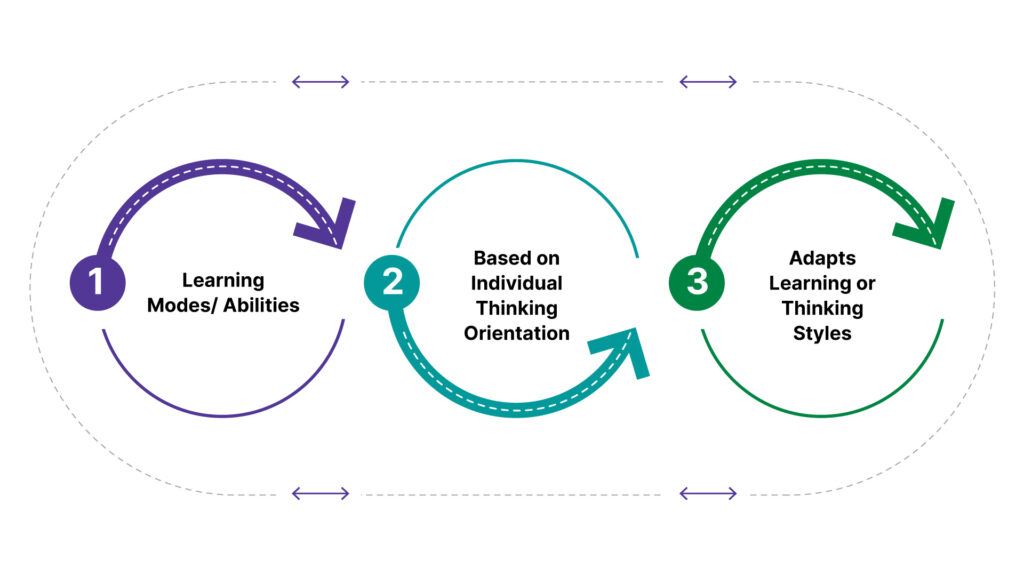
At the heart of experiential learning lies the Learning Cycle:
Learning = Grasping Experience + Transforming Experience
- Grasping Experience
- Concrete Experience (learning through feeling and doing)
- Abstract Conceptualization (learning through thinking and theory)
- Transforming Experience
- Reflective Observation (learning through observing and reflecting)
- Active Experimentation (learning through action and application)
This cycle is not linear—it is fluid and continuous. Learners move between these modes depending on the situation, making learning dynamic and adaptable.
Learning Ability vs Learning Style
These two terms are often confused but are fundamentally different:
- Learning Ability refers to how a learner processes and transforms experience (the four modes in the learning cycle).
- Learning Style refers to how a learner prefers to receive information (visual, auditory, reading/writing, kinesthetic).
In simple terms:
- Learning styles = preference
- Learning abilities = process
True education focuses on strengthening abilities, not limiting learners to preferences.
The Four Core Learning Abilities
Every child learns through a combination of four key abilities:
1. Concrete Experience (Feeling & Experiencing)
Children learn through direct involvement, emotions, and sensory engagement. They prefer hands-on activities, storytelling, and real-life examples.
2. Reflective Observation (Watching & Reflecting)
These learners observe carefully, think deeply, and analyze before acting. They are thoughtful, patient, and capable of seeing multiple perspectives.
3. Abstract Conceptualization (Thinking & Theorizing)
They focus on logic, concepts, and structured understanding. These learners enjoy theories, models, and clear explanations.
4. Active Experimentation (Doing & Applying)
These learners take action, test ideas, and learn through trial and error. They are problem-solvers who thrive on practical application.
Key Insight: True learning happens when a child engages in all four abilities—not just one.
Individual Orientation: How Children Process Learning
Each child naturally leans toward certain learning abilities, forming their individual learning orientation. This influences how they internalize knowledge.
There are four primary orientations:
- Convergent Orientation
Focused on problem-solving and practical application - Divergent Orientation
Creative, imaginative, and idea-generating - Assimilative Orientation
Analytical, theory-driven, and structured - Accommodative Orientation
Action-oriented, intuitive, and experiential
Each orientation has its strengths. However, growth happens when children learn to move across all orientations rather than staying in one comfort zone.
The Role of Personality in Learning
Learning is not shaped by cognition alone—personality also plays a role.
For instance:
- Extroverted learners may prefer action and discussion
- Introverted learners may prefer reflection and internal processing
These tendencies influence how children engage with the learning cycle, making each learner unique.
Why the Learning Cycle Matters
Learning becomes meaningful only when a child:
- Experiences something
- Reflects on it
- Understands it conceptually
- Applies it in real life
This continuous cycle transforms information into knowledge—and eventually into wisdom.
Education, therefore, should not focus only on delivering content but on creating experiences that encourage:
- Real-world application
- Deep thinking
- Active engagement
Conclusion: From Knowledge to Wisdom
Learning is not about memorizing facts—it is about transforming experiences. The four learning abilities are interconnected and together form the foundation of meaningful education.
While every child has natural preferences, true growth lies in developing the flexibility to engage across all modes. Individual orientation may determine where learning begins, but mastery comes from moving fluidly through the entire cycle.
Education must not aim to label learners—but to expand them.
As someone wisely said:-
We learn when we see,
We learn when we feel,
We learn when we ask
And when we reach out to touch..
From thought to action to insight,
The wheel keeps rolling,
Lighting what’s dark,
Into Quiet corners of wisdom!!!